
Quick answer: A teaspoon, abbreviated as tsp, is generally treated as 5 milliliters (mL) in everyday cooking. A US customary teaspoon converts to approximately 4.93 mL, but the difference is too small to affect most recipes.
In standard US kitchen measurements, one teaspoon also equals:
- 1/3 tablespoon
- 1/6 US fluid ounce
- 1/48 US cup
A recipe teaspoon should normally be measured with a marked measuring spoon rather than an ordinary spoon from a flatware drawer. This guide explains what a teaspoon looks like, how much it holds, and how to measure one when a standard spoon is unavailable.
What Is a Teaspoon?
A teaspoon is a small unit of volume used for liquid and dry ingredients.
Recipes commonly use teaspoons for:
- Salt
- Spices
- Baking powder
- Baking soda
- Yeast
- Vanilla extract
- Oil
- Sauces
- Lemon juice
The standard abbreviation is tsp. Some older recipes may use t, ts, or tspn.
The abbreviation Tbsp normally means tablespoon. It should not be confused with tsp because a standard US tablespoon holds three times as much as a teaspoon.
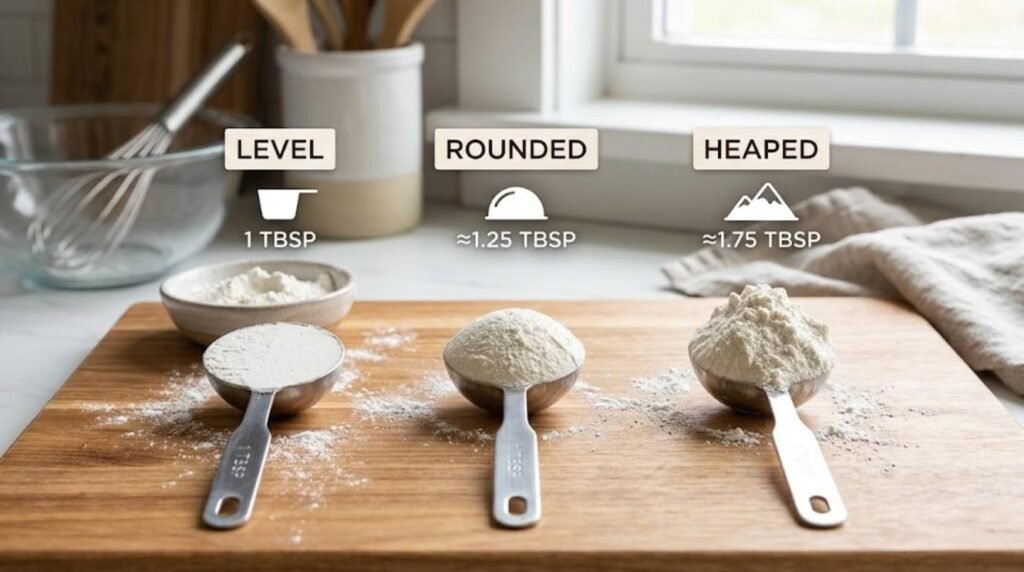
Unless a recipe says otherwise, “one teaspoon” means one level measuring teaspoon.
Quick Teaspoon Size Reference
| Measurement | Equivalent |
| 1 metric teaspoon | 5 mL |
| 1 US customary teaspoon | Approximately 4.93 mL |
| 1 teaspoon | 1/3 standard US tablespoon |
| 1 teaspoon | 1/6 US fluid ounce |
| 1 teaspoon | 1/48 US cup |
The NIST conversion table lists one US teaspoon as approximately 4.93 mL. The FDA’s household-measure guidance uses 5 mL as one teaspoon for US nutrition labeling.
For fractional teaspoons, larger amounts, formulas, and reverse conversions, use our complete teaspoon-to-milliliter conversion chart.
Want to convert teaspoons into milliliters, tablespoons, cups, or other units? Try our free cooking measurement calculator for an instant result.
What Does a Measuring Teaspoon Look Like?
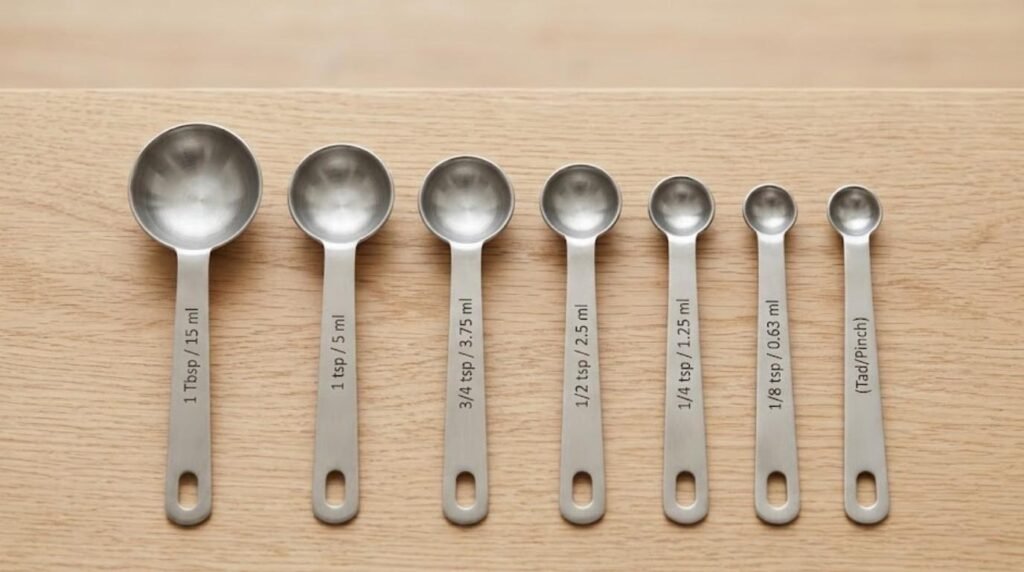
A measuring teaspoon is normally part of a measuring-spoon set. It is usually smaller than the tablespoon and may sit beside the 1/2-teaspoon and 1/4-teaspoon measures.
Look for one of these markings:
- 1 tsp
- 1 teaspoon
- 5 mL
The bowl can be round, oval, narrow, or deep. Different manufacturers use different shapes, so appearance alone is not a reliable way to identify the correct spoon.
The printed measurement is more important than the spoon’s shape.
When filled level, a metric measuring teaspoon holds 5 mL.
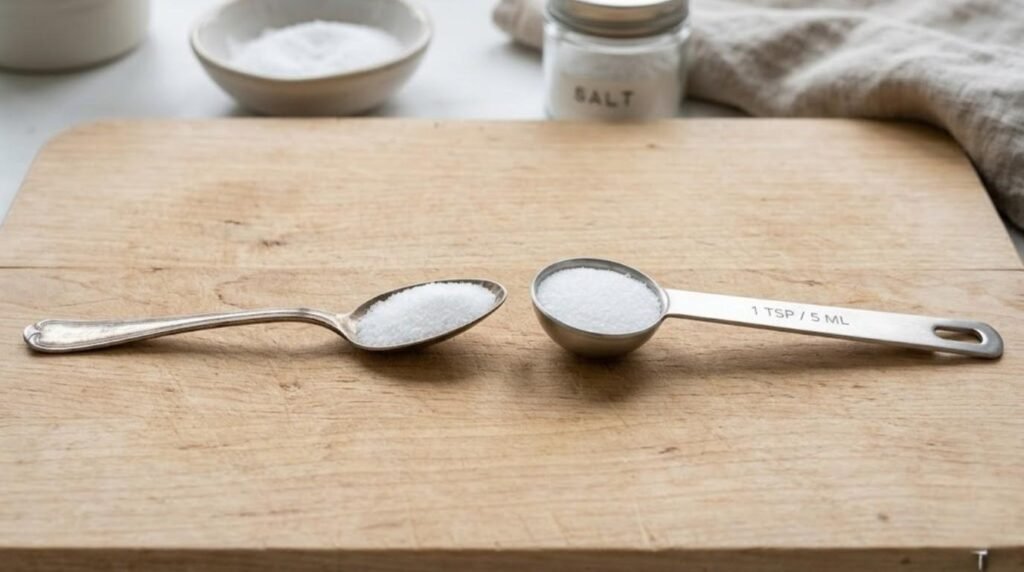
Is a Regular Spoon the Same as a Teaspoon?
Not necessarily.
The small spoon used for stirring tea or coffee is often called a teaspoon, but it is a piece of tableware rather than a calibrated measuring tool.
Household spoons vary by:
- Manufacturer
- Design
- Shape
- Depth
- Age
- Intended use
One ordinary spoon may hold close to 5 mL, while another may hold noticeably more or less.
To test a household spoon:
- Fill it with water.
- Pour the water into a container marked in milliliters.
- Check whether it reaches the 5 mL line.
If it reaches 5 mL, the spoon is reasonably close to a standard teaspoon. Even then, a marked measuring spoon is more reliable.
Level, Rounded, Heaped and Scant Teaspoons
Recipe instructions sometimes describe a teaspoon as level, rounded, heaped, or scant. These amounts are not interchangeable.
Level teaspoon
A level teaspoon is filled to the rim and swept flat across the top.
This is the standard amount intended when a modern recipe simply says “one teaspoon.”
Rounded teaspoon
A rounded teaspoon has a small mound rising above the spoon’s rim.
It holds more than a level teaspoon, but the additional amount is not standardized.
Heaped teaspoon
A heaped teaspoon contains a larger mound above the rim.
The amount can vary considerably according to the ingredient, spoon shape, and the way the spoon is filled.
Scant teaspoon
A scant teaspoon contains slightly less than a full level teaspoon.
When accuracy matters, avoid guessing these amounts. Follow the recipe’s wording and use a proper measuring spoon.
Teaspoon vs. Tablespoon
The USDA measurement table gives the standard US relationship:
3 teaspoons = 1 tablespoon
In standard US measurements:
| Measure | Volume |
| 1 teaspoon | Approximately 5 mL for practical cooking |
| 1 tablespoon | 15 mL |
| 1 tablespoon | 3 teaspoons |
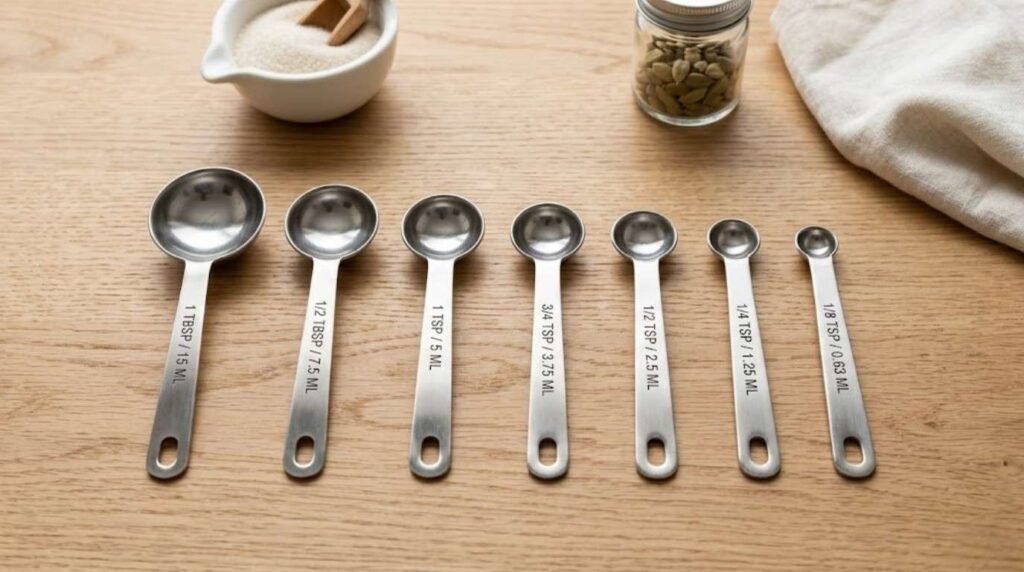
Mixing these two measurements can seriously affect a recipe.
For example, using one tablespoon of baking powder instead of one teaspoon triples the intended quantity. This can give baked goods a bitter taste, cause them to rise too quickly, or make them collapse.
Use these abbreviations carefully:
- tsp = teaspoon
- Tbsp = tablespoon
Avoid relying only on lowercase t and uppercase T, because they can be easy to misread.
Australian tablespoon exception
Australian recipes may use a 20 mL tablespoon. Australian Government cooking material defines:
- 1 teaspoon = 5 mL
- 1 tablespoon = 20 mL
That means an Australian tablespoon equals four metric teaspoons rather than three.
When following an Australian recipe, check its measurement notes before converting tablespoons to teaspoons.
How to Measure a Level Teaspoon
For a dry ingredient:
- Fill the measuring teaspoon slightly above the rim.
- Hold the spoon steadily.
- Sweep the flat edge of a knife across the top.
- Let the excess ingredient fall away.
- Use the amount remaining level with the rim.
For a liquid:
- Place the measuring spoon on a steady surface.
- Pour the liquid carefully.
- Fill it to the rim without creating a raised dome.
- Transfer it slowly to avoid spilling.
A level measurement is particularly important for baking soda, baking powder, yeast, salt, and strong spices.
How to Measure a Teaspoon Without Measuring Spoons
Without a proper measuring spoon, it is difficult to measure an exact teaspoon. The following alternatives may help, depending on the ingredient.
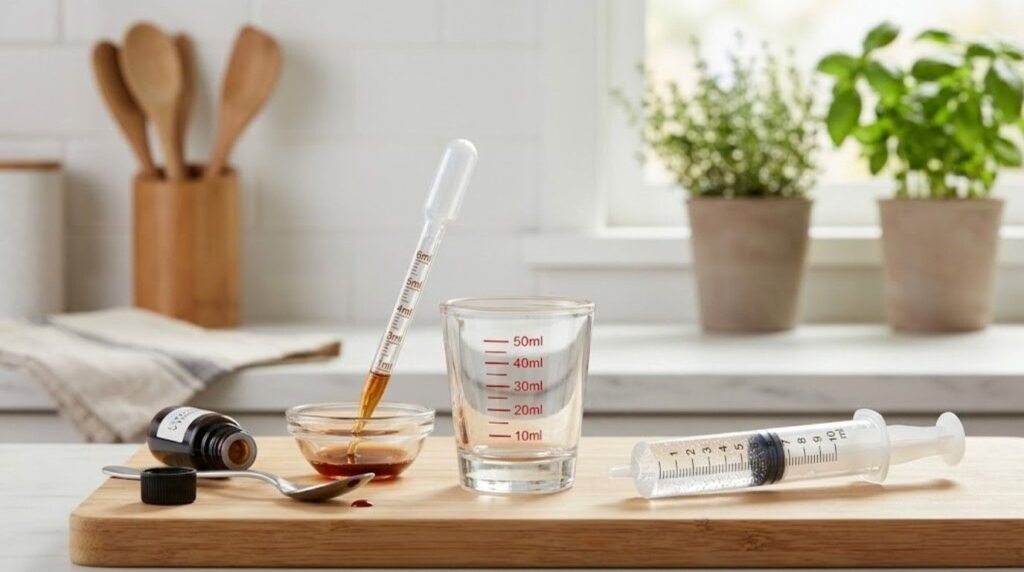
Use a milliliter-marked tool
For a liquid ingredient, measure 5 mL with:
- A small measuring cup
- A marked pipette
- A cooking syringe
- Another food-safe tool marked in milliliters
A milliliter-marked tool is more reliable than estimating with an ordinary spoon.
Use a tested kitchen spoon
Test a small kitchen spoon with 5 mL of water before using it.
Even when a spoon appears close to 5 mL, treat it as an estimate rather than a certified measurement.
Use a digital scale
A digital scale can help when you know the ingredient’s weight per teaspoon.
One teaspoon of water weighs approximately 5 grams, but this relationship does not apply to every ingredient.
A teaspoon of:
- Honey weighs more than water.
- Flour weighs less than water.
- Oil has a different weight from water.
- Salt and sugar do not have the same teaspoon weight.
Use an ingredient-specific gram conversion rather than assuming every teaspoon weighs 5 grams.
Estimate only in forgiving recipes
A rough estimate may be acceptable when seasoning soup, sauce, vegetables, or another dish that can be adjusted after tasting.
Do not rely on a visual estimate for:
- Baking soda
- Baking powder
- Yeast
- Medicine
- Salt in precision baking
- Ingredients used in very small but important quantities
How to Measure 1/3 Teaspoon
One-third of a metric teaspoon is approximately 1.67 mL.
Because many measuring-spoon sets do not include a 1/3-teaspoon measure, use one of these approaches.
For liquids
Measure approximately 1.7 mL with a small marked pipette or syringe reserved only for food preparation.
For dry ingredients
If absolute precision is not necessary, measure one level teaspoon and divide the ingredient into three approximately equal portions. Use one portion.
Use ingredient weight
When the ingredient’s weight per teaspoon is available, divide that weight by three.
For example, if one teaspoon of an ingredient weighs 6 grams:
6 ÷ 3 = 2 grams
One-third of a teaspoon would therefore weigh approximately 2 grams for that particular ingredient.
Increase the recipe
Another option is to triple the complete recipe.
An ingredient listed as 1/3 teaspoon then becomes one full teaspoon, which is easier to measure accurately.
Do not automatically replace 1/3 teaspoon with a rounded 1/4 teaspoon when measuring an ingredient that can affect the recipe’s structure or taste.
Cooking vs. Medicine: When the Exact Size Matters
In everyday cooking, the difference between 4.93 mL and 5 mL is normally too small to affect the result.
Liquid medicine requires more careful measurement.
Follow the dose written on the medicine label and use the oral syringe, medicine spoon, or calibrated dosing cup supplied with the product. FDA guidance recommends that oral liquid dosing devices use metric milliliter markings consistent with the labeled dose.
Do not use a household kitchen teaspoon to measure liquid medicine. Ordinary spoons are not calibrated and may deliver the wrong amount.
Teaspoons Measure Volume, Not Weight
A teaspoon measures volume. It tells you how much space an ingredient occupies.
Grams measure mass or weight.
That is why one teaspoon of flour, honey, oil, salt, and water does not weigh the same amount.
Use:
- Measuring spoons for teaspoon measurements
- Milliliter-marked tools for mL measurements
- A digital scale for gram measurements
Do not convert teaspoons directly into grams unless you have a conversion for the specific ingredient.
Frequently Asked Questions
Is 5 mL the same as one teaspoon?
Yes. Five milliliters equals one metric teaspoon. A US customary teaspoon is approximately 4.93 mL, but the difference is not important for most recipes.
What does a teaspoon look like?
A measuring teaspoon is a small spoon marked “1 tsp,” “1 teaspoon,” or “5 mL.” The bowl shape varies by manufacturer.
Is a regular kitchen spoon one teaspoon?
Not reliably. A tableware teaspoon may hold more or less than 5 mL because ordinary spoons are not standardized.
Is a recipe teaspoon level or heaped?
Unless the recipe specifically says rounded or heaped, assume it means one level measuring teaspoon.
What is a heaped teaspoon?
A heaped teaspoon contains a mound of ingredient above the rim. It holds more than a level teaspoon, but it is not a standardized quantity.
What is a scant teaspoon?
A scant teaspoon is slightly less than one full level teaspoon.
What is the difference between a teaspoon and a teaspoonful?
In most modern recipes, both terms refer to one level measuring teaspoon unless words such as heaped, rounded, or scant are included.
What does tsp mean in cooking?
The abbreviation tsp means teaspoon. It normally represents a 5 mL metric cooking measure.
How many teaspoons are in a tablespoon?
A standard US 15 mL tablespoon contains three teaspoons. An Australian 20 mL tablespoon contains four metric teaspoons.
How big is half a teaspoon?
Half a metric teaspoon equals 2.5 mL.
How big is one-quarter teaspoon?
One-quarter of a metric teaspoon equals 1.25 mL.
Can I use a normal spoon instead of a measuring teaspoon?
You can use a tested household spoon as a rough estimate in a forgiving recipe, but a marked measuring spoon is more accurate.
More Kitchen Measurement Guides
For detailed numerical conversions, use our teaspoon-to-milliliter chart.
For larger kitchen measurements, read:
The Bottom Line
A teaspoon is generally treated as 5 mL in everyday cooking. A US customary teaspoon converts to approximately 4.93 mL.
Use a measuring spoon marked 1 tsp or 5 mL for the most reliable result. An ordinary kitchen spoon may be close, but its volume is not guaranteed.
In standard US recipes, three teaspoons equal one 15 mL tablespoon. Australian recipes may use a 20 mL tablespoon equal to four teaspoons.
When measuring liquid medicine, follow the label and use the calibrated dosing tool supplied with the product rather than a household spoon.