
750 ml equals 25.36 US fluid ounces. Most labels round that to 25.4 oz. In the UK imperial system, the same volume is 26.40 fluid ounces. To convert it yourself, divide 750 by 29.5735. That is how many milliliters sit in one US fluid ounce.
Short on time? Pop any number into our kitchen measurement converter. It shows US and imperial ounces side by side.
Converting 750 ml to Fluid Ounces
750 milliliters is approximately 25.4 ounces. More precisely, 750 ml equals about 25.36 US fluid ounces. You get this by dividing 750 by 29.5735, the number of milliliters in one US fluid ounce. So the quick answer to how many ounces in 750 ml is just over 25 — a touch more than three cups.
Before you trust any single number, settle one thing: the word ounce hides two different units. An ounce of weight measures mass, while a fluid ounce measures volume. Since 750 ml is itself a volume, you must convert it into fluid ounces, never into weight. Mixing them up is the classic slip. Density is what makes that gap matter.
There is also more than one fluid ounce in play. The U.S. fluid ounce is defined as 1/128th of a U.S. gallon and works out to about 29.57 ml. The older Imperial fluid ounce, still seen in British recipes, is slightly smaller at 28.41 ml. That small difference is why 750 ml reads as 25.36 US fl oz but closer to 26.4 imperial — a gap worth respecting in any British recipe (fluid ounce definitions).
The math itself is refreshingly plain. Pick your variant—US or imperial—then simply divide 750 by the right factor: 750 ÷ 29.57 for the US figure, or 750 ÷ 28.41 for the imperial one. These are the only two different units you need to juggle, and once you know which system your measurement belongs to, the conversion result falls out in one step with no guesswork.
Reading 750 ml on Labels and in Scientific Notation
A quick word on labels, since they trip people up. A milliliter (mL) is a metric unit of volume equal to 1/1000th of a liter, and it is the same as a cubic centimeter (cc). A fluid ounce carries the common abbreviations fl oz and oz fl. Knowing the abbreviation for each keeps your notes clean when you are scaling a recipe or decoding a bottle label at a glance. Spoon measures follow the same metric logic, as our guide on how many mL in a teaspoon shows.
For anyone who likes precision, scientific notation tidies these figures up. Written in standard form, 750 ml becomes 7.5 × 10² milliliters, and its converted value sits at roughly 2.53605 × 10¹ ounces. That exponential notation uses base ten and a clean exponent to shift the decimal point, trimming the number to its meaningful significant figures without changing a thing about the actual amount.
In plain English, then, think of 750 ml as “about 25 and a third ounces” for everyday pouring, and reach for 25.36 when accuracy counts. The tool behind the number — whether a calculator or a scrap of mental math — only works once you have named your unit of volume honestly. Get that right, and the rest is arithmetic you can do on the back of a receipt.
mL to oz Conversion Chart
A conversion chart turns the raw math into a number you can read at a glance. Across the common volumes, 750 mL equals 25.36 US fluid ounces or 26.40 imperial fluid ounces — the same bottle, two different readings. Need an in-between value, like 752 mL? Divide it by 29.5735 for 25.43 fl oz. Or let the converter at the top do the work.
The spread of a good chart is what makes it useful. It runs from a 10 mL sample vial at 0.34 US fl oz up to a 3.75 L large-format bottle at 126.80 — covering the sizes people actually search, like 187 mL, 375 mL, 500 mL, and a full litre at 33.81 oz. Reading across both columns at once shows you the US and imperial figures side by side, so you never have to guess which measurement system a recipe or label intends.
Milliliters to US and imperial fluid ounces
| mL | US fl oz | Imperial fl oz |
| 10 mL | 0.34 | 0.35 |
| 15 mL | 0.51 | 0.53 |
| 20 mL | 0.68 | 0.70 |
| 25 mL | 0.85 | 0.88 |
| 30 mL | 1.01 | 1.06 |
| 40 mL | 1.35 | 1.41 |
| 50 mL | 1.69 | 1.76 |
| 60 mL | 2.03 | 2.11 |
| 80 mL | 2.71 | 2.82 |
| 100 mL | 3.38 | 3.52 |
| 120 mL | 4.06 | 4.22 |
| 150 mL | 5.07 | 5.28 |
| 187 mL | 6.32 | 6.58 |
| 200 mL | 6.76 | 7.04 |
| 250 mL | 8.45 | 8.80 |
| 300 mL | 10.14 | 10.56 |
| 331 mL | 11.19 | 11.65 |
| 350 mL | 11.83 | 12.32 |
| 355 mL | 12.00 | 12.49 |
| 375 mL | 12.68 | 13.20 |
| 475 mL | 16.06 | 16.72 |
| 500 mL | 16.91 | 17.60 |
| 570 mL | 19.27 | 20.06 |
| 700 mL | 23.67 | 24.64 |
| 710 mL | 24.01 | 24.99 |
| 720 mL | 24.35 | 25.34 |
| 750 mL | 25.36 | 26.40 |
| 900 mL | 30.43 | 31.68 |
| 945 mL | 31.95 | 33.26 |
| 1 L | 33.81 | 35.20 |
| 1.5 L | 50.72 | 52.79 |
| 1.75 L | 59.17 | 61.59 |
| 1.8 L | 60.87 | 63.35 |
| 2 L | 67.63 | 70.39 |
| 3 L | 101.44 | 105.59 |
| 3.75 L | 126.80 | 131.98 |
Three habits keep your readings honest. First, every figure here is rounded to two decimals from an exact calculation, never from an already-converted value, so rounding errors never stack up — so the last digit always stays honest. Second, the US and imperial columns are never interchangeable: 25.36 and 26.40 describe the identical volume in rival systems. Third, when the work demands real precision — filling specifications, lab dilutions, or regulatory paperwork — skip the chart and run the full factor through the converter at the top.
How to Convert Between mL and US Fluid Ounces
Converting Millilitres to US Fluid Ounces
To change millilitres into US fluid ounces, you divide by a single fixed number. One US fluid ounce is defined as exactly 29.5735295625 mL under NIST Handbook 44, so the formula is simply: US fl oz = mL ÷ 29.5735295625. There is no second step and no guesswork once you know the factor.
A worked example makes it stick. Take 350 mL: dividing by the factor gives 11.8349, which rounds to 11.83 US fl oz. For a fast sanity check, remember that 30 mL is a shade over one fluid ounce, so 350 mL should sit just under 12 — and it does. Dividing by 30 in your head lands within about 1.4% of the true value, which is fine for a rough estimate but never for labels, specifications, or anything contractual.
Converting Fluid Ounces Back to Millilitres
The reverse conversion runs the same factor the other way: mL = US fl oz × 29.5735295625. Convert 12 US fl oz and you get 354.88 mL, which is exactly why the familiar twelve-ounce serving ships as a 355 mL can or bottle. That 355 is the nearest whole-millilitre capacity, and the 0.12 mL gap falls far below any filling tolerance.
This logic quietly explains a string of “odd” metric sizes. A 1.5 oz shot works out to 44.36 mL, a US pint to 473 mL, and a US quart to 946 mL — each one just a fluid-ounce count run through the same multiplication. Once you see the factor behind them, the strange numbers on bottles and jiggers stop looking arbitrary. For the kitchen side of those sizes, see how many cups in a pint and how many cups in a quart.
Are US and Imperial Fluid Ounces the Same?
No — and the gap is bigger than most people expect. One US fluid ounce is about 29.5735 mL, while one imperial (UK) fluid ounce is exactly 28.4130625 mL, leaving a difference of 1.1604670625 mL. In plain terms, the American unit is roughly 4.1% larger than its British counterpart, so the two are never safely swapped.
The split is a quirk of history. In the 19th century the two systems drifted apart: Britain redefined its gallon by the volume of ten pounds of water, while the United States held onto the older English wine gallon. Every conversion on this topic therefore exists in two versions, and mixing them up breeds errors large enough to spoil recipes, lab work, and packaging specifications.
Here is the practical tell. British and Commonwealth sources label a 750 mL bottle as 26.4 oz; American sources call the same bottle 25.4 oz. Both are correct, because each is counting a different ounce. Whenever a document only says “oz,” confirm which system it means before you trust the figure.
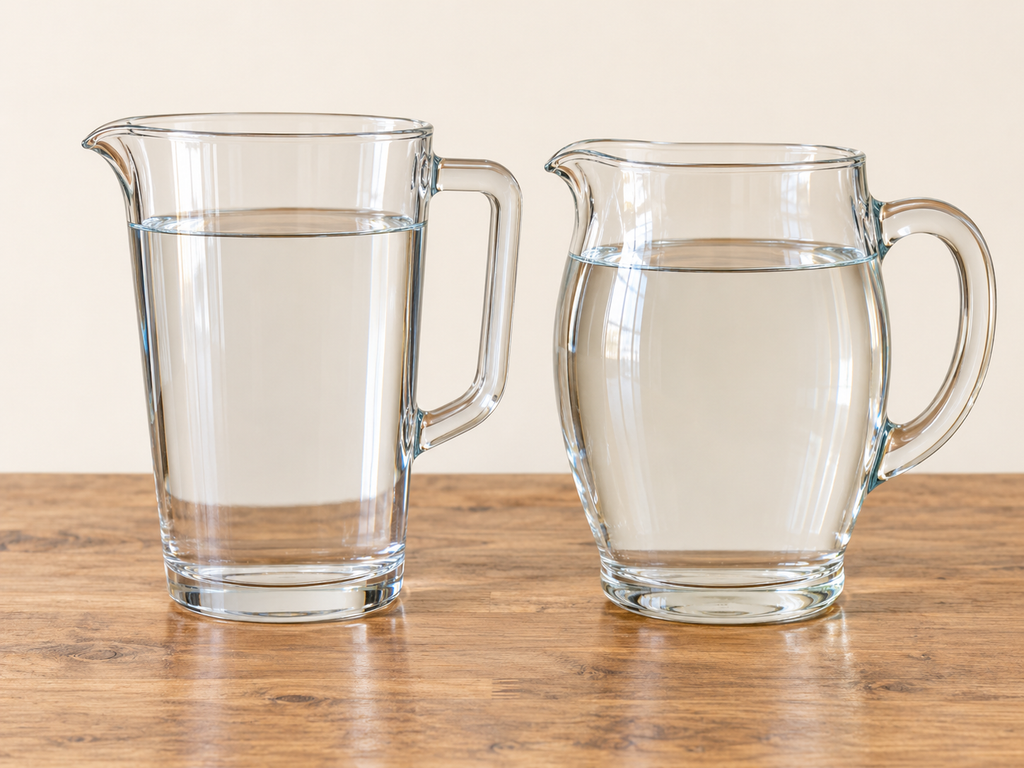
| Unit | Millilitres |
| 1 US fl oz | 29.5735295625 mL |
| 1 imperial fl oz | 28.4130625 mL |
| Difference | 1.1604670625 mL (US is ≈ 4.1% larger) |
Fluid Ounces Measure Volume, Not Weight
A fluid ounce is a unit of volume; the ounce on a kitchen scale is a unit of weight, or mass. They are genuinely different quantities that happen to share a name, and treating them as one is where conversions go wrong. One US fluid ounce of water weighs about 1.04 ounces, a fluid ounce of honey roughly 1.5 ounces, and one of olive oil about 0.96 ounces — identical volume, different weights, because density differs.
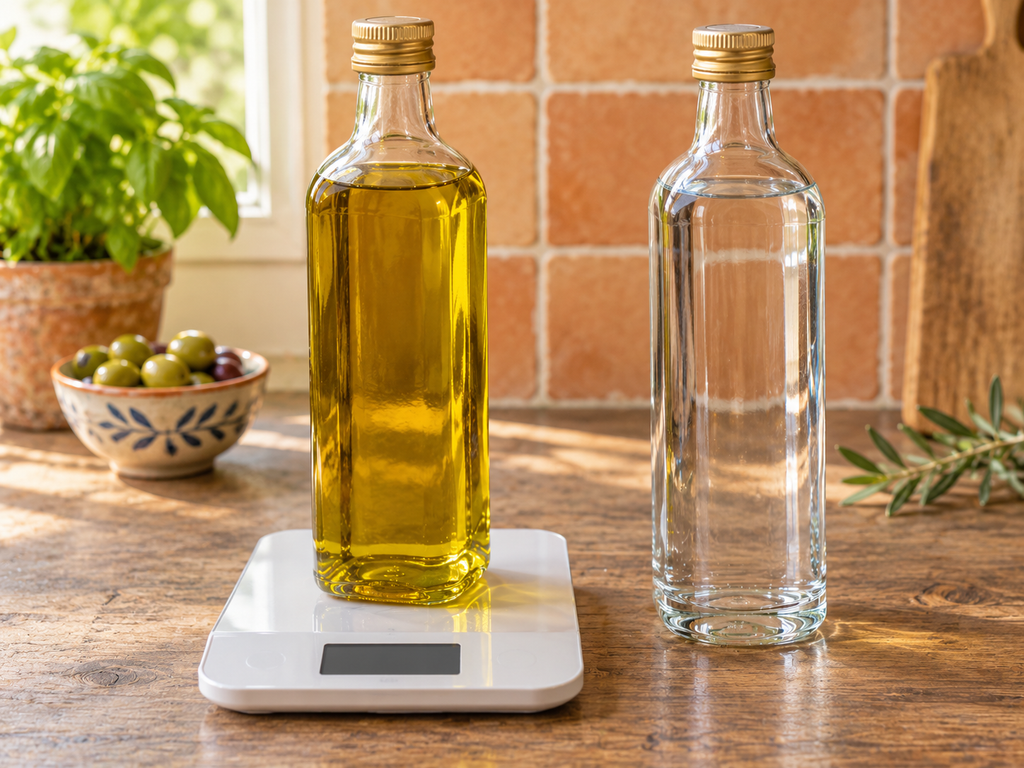
That distinction has teeth in the kitchen. You cannot measure “8 oz of flour” in a liquid measuring cup, since that figure is a weight, and 100 mL of syrup does not weigh 100 grams. Volumes convert cleanly among millilitres, litres, and fluid ounces; grams and weight-ounces only join the chain once you also know the density of the actual substance.
The same trap hides on supermarket shelves. A 16 oz jar of honey is sold by weight, not volume. A 16-fluid-ounce jar of liquid holds about 473 mL instead. Those two jars are not the same size at all. So check the label for “fl oz” or “net wt” first. That tiny word tells you which ounce you are holding. It saves real confusion before you pick a bottle or jar.
What 750 ml Means in a Mediterranean Kitchen
A 750 ml bottle is the size most olive oil comes in. So it helps to know what one bottle gives you. In US kitchen terms, it holds about 3.17 cups. That equals 50.7 tablespoons, or roughly 152 teaspoons. In 250 mL metric cups, it is exactly three.
Here is the part most charts skip. Olive oil is lighter than water. Its specific gravity sits near 0.911, per Wikipedia’s olive oil entry. So a full 750 ml bottle weighs about 683 grams. That is roughly 24.1 ounces on a kitchen scale. The same bottle of water weighs 750 grams, or 26.5 ounces.
Say a recipe asks for half a cup of olive oil. Half a US cup is about 118 mL. One bottle covers that recipe six times, with a splash left. Drizzle one tablespoon per salad, and it lasts about 50 salads. [PLACEHOLDER: add one true line from your own kitchen here.]
| 750 ml of… | Volume | Approx. weight |
| Water | 25.36 US fl oz / 3.17 cups | 750 g (26.5 oz) |
| Olive oil | 25.36 US fl oz / 50.7 tbsp | 683 g (24.1 oz) |
Stocking up for the week? Our Mediterranean diet pantry list shows where that bottle fits.
Measurement Techniques for Accurate Results
For precise applications, a few reliable tools turn a 750ml volume into a trustworthy number. Graduated cylinders give the most accurate volume readings, digital kitchen scales can stand in for millilitres with water, since 1 mL of water weighs about 1 gram, and measuring cups printed with ml/oz markings cover most everyday needs in kitchens and bars. Each suits a different level of accuracy, from lab-grade to a quick bartending pour.
One check matters before you trust any reading. When moving between measurement systems, confirm whether the figure is in US fluid ounces or Imperial (UK) fluid ounces, because the two differ slightly and silently swapping them introduces error — the same roughly 4.1% gap covered above.
Quick mL and oz Facts Worth Knowing
One US fluid ounce is 29.5735295625 mL and one imperial fluid ounce is exactly 28.4130625 mL under their official definitions. For speed, “about 29.6 mL” or “about 28.4 mL” works day to day, but the full factors belong on anything printed as a label or specification. The familiar rounding of an ounce to 30 mL overstates the real unit by roughly 1.4%, even though FDA nutrition labelling rules define it as exactly 30 mL for serving sizes.
Everyday sizes map onto these numbers neatly. 100 mL (3.38 US fl oz) is the airline carry-on liquid limit, usually printed as 100 mL / 3.4 oz. Twelve US fl oz equals 354.88 mL, which is why the standard can is 355 mL, the nearest whole millilitre; in older UK packaging the same twelve ounces read as 340.96 mL. A standard US shot of 1.5 fl oz is 44.36 mL, with a 1 oz pour at 29.57 mL, a 1.25 oz at 36.97 mL, and a 2 oz double at 59.15 mL.
The History and Density Behind mL to oz Numbers
Measurement systems and history explain the rest. Britain redefined its gallon in 1824 around ten pounds of water, while the US kept the older English wine gallon of 231 cubic inches; each divides into 128 US or 160 imperial ounces, leaving the two about 4.1% apart. That is why a single 750 mL bottle is a “25-ounce fifth” in American usage and a “26 oz bottle” in older Canadian labelling — same glass, two ounce systems. To convert litres yourself, multiply by 33.814 for US or 35.195 for imperial fluid ounces, so 2 L is 67.63 and 3 L is 101.44.
The deepest trap is still volume versus weight. A fluid ounce measures volume; the scale ounce measures mass, and the two only align for water-like liquids — one imperial fluid ounce of water weighs almost exactly 1 oz by the system’s original design, while a US fluid ounce of water weighs about 1.04 oz. Density decides everything else: 40 mL of vegetable oil weighs about 37 g, yet 40 mL of honey weighs roughly 57 g, so there is no universal mL-to-gram factor. The same care applies in the kitchen, where 250 mL is 1.057 US customary cups but exactly one metric cup used in Australia — a 6% gap that quietly matters in baking. Scaling a recipe between systems? Our recipe scaler calculator keeps the maths straight.
750 ml to Ounces: Quick Questions Answered
Is 750 ml exactly 25 ounces?
Not quite. 750 ml is 25.36 US fluid ounces. That extra 0.36 ounce is about 10.6 mL. It is roughly two teaspoons of liquid.
How many cups are in 750 ml?
750 ml is about 3.17 US cups. Each US cup holds 236.6 mL. Australian-style 250 mL cups give you exactly three.
How many tablespoons are in 750 ml?
You get about 50.7 US tablespoons from 750 ml. One US tablespoon holds 14.79 mL. Our tablespoons to mL guide covers the smaller amounts.
Does 750 ml of olive oil weigh 750 grams?
No, it weighs less. Olive oil is lighter than water. A full 750 ml bottle weighs about 683 grams, or 24.1 ounces.
How many glasses of wine are in a 750 ml bottle?
About five, at a 5-ounce pour. That pour is the US standard drink for wine, per the NIAAA standard drink guide. Bigger 6-ounce pours give you about four glasses. Our 750ml bottle guide has the full servings breakdown.